Sunday, 10 July 2011

Using ICT to compete in the global economy ( Article on 08/07/2011)

Writter : John Loh
Sources : The Star


Friday July 8, 2011


KUALA LUMPUR: Local businesses must make use of the latest information and communication technology (ICT) solutions to enhance their productivity and to compete in the global economy, said SME CorpMalaysia CEO Datuk Hafsah Hashim.
She said one of the criteria for developed countries was that small and medium enterprises (SMEs) should contribute to at least 40% of the gross domestic product (GDP), but local SMEs currently contributed 31% to GDP.
“This means that SMEs have to grow 1% or more per annum to reach the desired 40% by 2020 (the year Malaysia aims to achieve a developed-nation status). We need a leapfrog growth driven by innovation and productivity,” she said at the launch of Microsoft's Office 365 cloud computing service.
The launch marked the beginning of a private-public partnership between SME Corp and Microsoft Malaysia to enhance the take-up of cloud computing among Malaysian businesses.
Office 365 is Microsoft's newest ICT solution that utilises cloud computing to integrate business function over four primary products - office, sharepoint online, exchange online, and lync online.
“SME Corp and Microsoft will also promote the cloud service through joint roadshows as well as a Microsoft booth in SME Corp's new one-stop referral centre in KL Sentral,” Microsoft Malaysia managing director Ananth Lazarus told StarBiz.
Hafsah also said SME Corp would use the SME Competitiveness Rating for Enhancement (Score) programme to evaluate the ICT effectiveness of SMEs. SME Corp will take the lead in adopting cloud computing by using Office 365 in their KL Sentral office.

ICT Zone offers investment scheme

Writter : June Ramlee
Sources : Business Times


KUALA LUMPUR: ICT Zone Ventures Bhd is looking for investors from all walks of life to invest in its rental business of electronic equipment such as personal computers, notebooks and projectors, services and software solutions to offices and government institutions.

Its chief executive officer Lim Kok Kwang said the company is offering 22,000 units equivalent to RM110 million of shares up for grabs to anyone who is above 18 years old including foreigners.

"Each unit is RM5,000 and this investment maturity date ends on March 27 2020. When they invest with us under this ICT scheme they will get a return of 8 per cent per annum for the next nine years until the scheme ends," Lim told Business Times in an interview, recently.

Lim said once the scheme reached its maturity date in 2020, only then can investors recoup their entire investment with the company.

"In the meantime, investors who invest with us can check our financial records with the Companies Commission of Malaysia (SSM) which will be renewed every six months," he said.

He also said that investors' capital is protected within the cumulative nine-year redemption reserve fund, which is managed by a trustee called My Premier Trustee (Malaysia) Bhd that is approved by Bank Negara Malaysia and SSM.

An independent consultant Pannell Kerr Forster (PKF) accountants will audit the interest scheme every six months to validate its governance.

He said the scheme, which comes under the Companies Act 1965, is another type of scheme which allows small and medium enterprises to raise funds if they are not qualified yet to go for listing.

"We are the first ICT company approved by SSM to be qualified for this scheme. Prior to this only three companies have been approved to raise money from this scheme and they are all from the agricultural sector," Lim said.

He said the company had been approved to collect funds under this scheme on March 28 this year and would launch the fund on a bigger scale sometime in mid July.

According to Lim, the company has over RM50 million worth of electronic equipment and plans to invest another RM10 million this year to purchase more personal computers and other office equipment which can be rented out to its clients.

On the company's performance, Lim said he expects the company to do well this year with a growth of at least 30 per cent by year end.

"Since our establishment in 2001, we have been growing year on year basis on a 30 per cent rate. That is normal for us. However, I hope our growth can surpass the 30 per cent mark this year," he said, adding that the company made a net profit or RM1 million last year.

At present, its cliental includes University Teknologi Mara, The Education Ministry, Kuala Lumpur Convention Centre and Popular bookstore to name a few.


Read more: ICT Zone offers investment scheme http://www.btimes.com.my/Current_News/BTIMES/articles/jrict/Article/#ixzz1RgyH781x

Asean launches ICT Masterplan 2015

Writter : Azlan Abu Bakar


KUALA LUMPUR: The Association of Southeast Asian Nations (Asean) today launched a plan that will harness the potential of information and communication technology (ICT) in the region, to help in establishing an inclusive, vibrant and integrated Asean community.


The Asean ICT Masterplan 2015 is comprehensive and has specific actions and projects with clear targets and timelines in six strategic thrusts to be implemented in the next five years.

"It aims to deliver four key outcomes namely ICT as an engine of growth, recognition of Asean as global ICT hub, enhanced quality of life and contributions towards Asean integration," Information, Communications and Culture Minister Datuk Seri Dr Rais Yatim said.

Speaking to reporters on the final day of the Asean Telecommunications and IT Ministers meeting in Kuala Lumpur today, he said: "We (Asean ministers) welcome and invite all relevant stakeholders and parties to support and actively contribute to the implementation of actions and measures embodies in the masterplan."


Rais said the ministers have tasked their respective senior officials to review the existing ICT cooperation.

These include amongst others the Asean e-commerce database, international mobile data roaming charges and interoperability framework in Asean projects.

"The senior officials will also need to identify available funding sources to come up with the recommendations to ensure timely implementation of the masterplan for consideration at the ministers next meeting," he said.


Read more: Asean launches ICT Masterplan 2015 http://www.nst.com.my/nst/articles/AseanlaunchesICTMasterplan2015/Article/#ixzz1RgxOSqY2

Pikom ICT Mall to open in Sept

Writter : SUBASHINI SELVARATNAM
Sources : Tech Central


KUALA LUMPUR: Gadget hunters will have an alternative place to shop for the latest products when the Pikom ICT Mall opens at the CapSquare centre here on Sept 15.
The four-storey mall will offer a wide range of ICT products and gadgets such as Tablet PCs, notebooks, PC products and peripherals, broadband products, media players, GPS products and Internet TV players.
"New ICT product launches, product previews, product trainings and seminars as well as special appearances by brand ambassadors will be held at the mall," said Wei Chuan Beng, the chairman of Pikom (The National ICT Association of Malaysia).
The CapSquare centre currently houses a mix of F&B, entertainment and service outlets that will be complementary to the new ICT-based retail outlet. A total of 84,299sq ft of retail space has been set aside for the Pikom ICT Mall.
Some of the confirmed tenants include Apple, HP, Acer, Lenovo, Garmin, Tom Tom GPS, Imation, Digi and Celcom.

Technical rebound for ECS ICT likely

Writter : S.N.Lock
Sources : Business Times


SHARE prices on Bursa Malaysia continued to consolidate lower in tandem with the technical pullback on the Hong Kong Stock Exchange yesterday. Declining counters outpaced advancing counters by 354 to 351.


The FTSE Bursa Malaysia Kuala Lumpur Composite Index (FBM KLCI) fell from its intra-day high of 1,526.18 to its intra-day low of 1,520.18 yesterday. It closed at 1,521.18 points, giving a day-on-day loss of 7.25 points, or 0.47 per cent. 
ECS ICT Bhd's price trended higher to close at RM1.60, giving a day-on-day gain of 10 sen, or 6.67 per cent.

Chartwise, ECS's daily price trend fell from its recent high of RM1.70 on April 8 to its intra-day low of RM1.48 on Wednesday, posting a total loss of 22 sen, or 12.94 per cent.


Its 60-minute price trend staged a technical breakout of its short-term downtrend (B1:B2) yesterday and continued to stay above it.

Its 60-minute fast MACD (moving average convergence divergence) continued to stay above its daily slow MACD yesterday. Both of its daily fast and slow MACDs continued to stay below their respective neutral reference lines.

ECS's 60-minute price trend is likely to stage an intermittent follow-through technical rebound, re-challenging its overhead resistance zone (RM1.62-RM1.75).

The subject expressed above is based on technical analysis and opinions of the writer. It is not a solicitation to buy or sell.

MALAYSIA BANKS ON ICT TO MEET 2020 DEVELOPMENT GOALS

Writter : Robin Hicks
Sources : Future Government


Malaysia’s Government CIO has hailed ICT as a “key enabler” to fulfil Prime Minister Datuk Seri Najib Razak’s mission to transform Malaysia into a developed nation by 2020. Speaking at the FutureGov Forum Malaysia in Kuala Lumpur on Tuesday (23rd February 2010), Dr Nor Aliah Zahri, Government CIO and Deputy Director General of the Malaysian Administration Modernisation & Planning Unit (MAMPU), said that the 2020 goal was a “reasonable target to attain”.
“We acknowledge that we face significant challenges,” Dr Aliah told delegates. “But we are seeing positive change as Malaysia continues to transform into an information-centred economy by focusing on innovation, value and high skills.”
Malaysia’s National Broadband Plan, which aims to see household broadband internet penetration rise from 26 per cent to 50 per cent by the end of this year (2010), will play a big part in connecting the country of 23 million people, Dr Aliah noted. If this target is met – Malaysia’sGDP, which has been sluggish during the global economic downturn, could grow by 1.2 per cent, she said.
The Government Transformation Roadmap Plan, introduced this year to improve government services, will help keep the 2020 vision on track, Dr Aliah said. “This is a bold and unprecedented plan for every ministry to ensure that every citizen enjoys the fruits of a growing nation,” she said.
Part of the plan is “Connected government”, an initiative launched in 2007 to boost information sharing, integration and interoperability among government agencies, and strengthen and unify ICT infrastructure. “We want to move towards zero face-to-face interaction for citizens for selected agencies as more services move online,” said Dr Aliah.
Another strategy has been to focus on a few “high-impact projects” that will deliver immediate results. One of the most successful to date is MySMS, which gives Malaysians one number – 15888 - to text government with complaints or queries and receive news about new services. The service already has 1.4 million users.
Similar in aim to MySMS is MyID, which enables Malaysians to use a single reference number when dealing with government agencies. Launched in January 2010, 760 services have been launched which use the MyID service to date.
Dr Aliah explained that the progress of these projects, and the public sector as a whole, will be closely monitored by giving the highest performing agencies a “Public Sector Trust Mark” which citizens or businesses can use to gauge transparency.
“If these initiatives are wholeheartedly embraced, the hope of the Malaysian government is that we will move towards a more systemic excellence culture,” she said.
“Malaysia’s public sector will continue to transform to deliver higher performance to meet the 2020 goal. But we still need to change the way the civil service operates. E-government in Malaysia is well advanced, and it should be an integral component of a much broader mission to deliver the transformation agenda.”
Malaysia was ranked 32nd in the United Nations E-Government Survey 2010 last month, moving up two places on its 2008 rank. Malaysia is the fifth highest placed Asian country in the rankings, behind Japan, Bahrain, Singapore and South Korea.
FutureGov Forum Malaysia is an annual event organised by FutureGov magazine in close cooperation with the Malaysian government authorities.
For more information on FutureGov Forum Malaysia visit the event website

Using ICT to Increase Impact of Agriculture Sector Development

Writter : Judith Payne
Sources : Micro Links


This seminar was the 59th installment of the Linking Small Firms to Competitiveness Strategies Breakfast Seminar Series sponsored by the USAID Microenterprise Development office.
Information and communications technologies (ICT) are being used in dozens of ways by USAID Feed the Future projects globally. Unfortunately most applications are not sustainable without on-going donor support; have not yet scaled to millions of farmers; and their impact has not yet been well measured.
USAID's Judy Payne provided an overview of some of the most promising ICT interventions that appear to be sustainable and scalable without on-going donor support and also help improve smallholder farmers’ productivity and incomes. Examples included applications that improve access to farm extension and advisory services; ease access to financial services for smallholder farmers; help large buyers better manage and reward 10,000s of producers; provide better market price information; and can help reduce post-harvest losses.
Payne also outlined some good practices related to technical and business models and addressed issues regarding measuring impact of such interventions. She drew upon work conducted under the USAID FACET Project and provided suggestions to help project implementers incorporate issues related to ICT into their value chain analyses.

Thursday, 7 July 2011

What does the Government really think about ICT?

Sources : ICT in Education 

I am by no means an apologist for the Government, but it seems to me that colleagues who have seized on the absence of ICT in the recent White Paper on the future of teaching as indicative of the Government's lack of interest in, or commitment to, ICT may have been premature. As an ex-Ofsted inspector I would say that absence of evidence is not evidence of absence. The White Paper failed to mention electricity as well, but I'm sure the Government would be surprised if anyone took that to mean the Government thought schools should be run on gas!
I wonder if, in fact, the lack of attention to ICT is more of an indication of a view that ICT in schools is already in place, so we can turn our attention elsewhere? This is certainly the impression I have come away with having spoken to certain people. Mr Gove does, in fact, recognise the importance of technology. In his keynote opening speech at the Education World Forum, he said:
Because with every year that passes we are privileged to enjoy new insights about how best to organise schools, how best to inspire pupils, how to use new technology, how the brain absorbs knowledge, how teachers can best motivate, how parents can better support, how governments can best invest. (my emphasis)
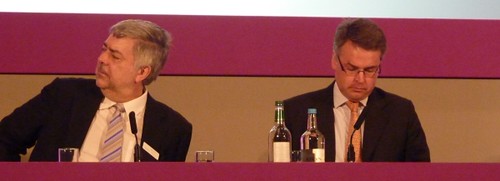
Dominic Savage (left) and Tim Loughton at BETT 2011At the BETT show, Tim Loughton, the Parliamentary Under-Secretary of State for Children and Families, placed a great deal of emphasis on educational technology. Well, he would, of course, given the occasion, which was the Leadership conference at the BETT show, but I thought he gave cause for optimism -- although I know some of my colleagues disagreed with me when I expressed this.
My cause for optimism and my colleagues' cause for pessimism were one and the same. Mr Loughton placed a great deal of emphasis on e-safety, which he said was a 21st century issue. He and his colleagues have even had a visit and talk by Tanya Byron.
Well, you can see why colleagues involved in e-safety issues would be upset by such a viewpoint. Many of us have tried hard, over the years, to convince people that e-safety is a whole school issue, not just an ICT issue, and I have long said that phenomena such as cyber-bullying are a subset of bullying, not a class of their own. From that point of view, the Government's approach appears to be putting the clock back, or to be a diversion from wider, and possibly even more important, issues -- such as how to teach young people to be safe rather than assuming that all can be solved with the right sort of internet filtering software.
I take a more sanguine view. The White Paper talks about the idea of teaching schools, akin to teaching hospitals. They present an opportunity for the ICT community to influence what is taught and what is held to be best practice. These teaching schools could be beacons of educational technology excellence.
As for the e-safety angle, surely an savvy ICT person would use that as a virtual foot in the door? Whilst showing government representatives or any other officials who visit your school your marvellous e-safety measures, why not show them the oher wonderful things you have in place too? The same applies when writing about educational technology.
Perhaps I am a hopeless optimist, but I think that if the Government is willing to listen to someone like Tanya Byron, it suggests that they willing to listen, full stop. Besides, dismissing other people's (perceived) point of view out of hand doesn't seem to me to be a particularly intelligent approach; nor does it seem likely to guarantee any kind of dialogue, let alone a fruitful one.
This article first appeared on 4th February 2011 in Computers in Classrooms, the free e-newsletter for educational ICT professionals.
Don't forget to contribute to the National Curriculum Consultation -- deadline: 14th April 2011.

In ICT, the past is not what it was

Written : Terry Freedman |
Sources : ICT in Education

From 1997 there was an almost palpable – some would say relentless – commitment to educational technology in the UK. Although not always strategic, it was both consistent and persistent. It was a qualitative as well as quantitative break with the past. Yet, whilst I would never disparage these efforts, I don’t believe they were necessarily as wonderful as people remember them to be.

Perhaps that is because my perspective is different from that of a teacher. New Labour took the reins of the country in May 1997, and just a few months later I left teaching to go into advisory work. In other words, I crossed the line from being the recipient for school ICT funding to being responsible for its dissemination. Here is what I learnt from the experience:

The National Grid for Learning (NGfL) funding


In order to access this, schools had to have an ICT strategy document, and that document had to address e-safety. All very laudable, but in practice:

  • Some schools used one of many downloadable templates in which all they had to do was insert the school’s name in the appropriate places.
  • Even where this didn’t happen, some schools needed more hand-holding than others. I recall sitting down with one Head of ICT saying, “… and I think it would be good at this point to say something about X; what do you think?” This was on every single point, and it would have been quicker, and less painful, for me to have written it myself and posted it to them.

Not all schools needed that sort of treatment, of course, and I daresay many schools benefited from the plethora of sample strategy documents that people produced. Indeed, I, as the author of such a document, gained enormously from the writing process itself, because I had to write something which was both concise and potentially relevant to all types of school. As in many cases, the journey was at least as useful as the arriving, perhaps even more so – but only for those of us who took an active interest in the journey.

The theoretical penalty for a school not meeting the strategy document requirements was the withholding of its funding. In practice, I doubt that ever happened. For one thing, who would know? The Department for Education cannot oversee 30,000 schools. Local Authority staff can concentrate only on schools which give cause for concern or those which buy into their services. In that respect the education system is – much like any other system I imagine – based, in effect, on the idea of the Panopticon, the brainchild of Jeremy Bentham. This is a prison designed in such a way that the warders may observe any prisoner at any time. The inmates know they can be watched, but they don’t know when they are being watched. So they behave constantly as though they are being watched. Similarly, schools self-regulate their “behaviour” in case they are inspected or otherwise descended upon by people who can pull them up over something they have or haven’t done.

But there is the political, with a small ‘p’, factor too. Who, being realistic, will tell a school that it does not deserve its funding? Even if the harbinger of such news could avoid being lynched, the failure of the school to meet the conditions would be seen as a failure on the part of the Local Authority to assist it to do so. No: by hook or by crook schools had to receive their NGfL funding, and all anyone could hope for was that its ICT strategy really was a living reference.

Targets


Schools were obliged to have an internet connection, and every year there would be statistics published which proclaimed something along the lines of  “95% of schools in the UK are now connected to the internet!” I always wondered how many of those schools defined “connected” as having a computer locked in a cupboard in the library for most of the week, but which was wheeled out on Wednesday afternoons when the part-time school librarian was working, and plugged into the telephone socket (the computer, not the librarian!).

That’s the trouble with targets: you can meet them without meeting them, if you see what I mean. When the person in charge of the intranet (PICOTI) in a Local Authority announced in a bulk email sent to Heads of Division that the intranet was now live, I went to see him:

Me: I suppose that by “live” you mean that there is one computer in the Council which has the intranet software on it, and it has now been plugged in and switched on?

Picoti: That’s right.

Me: And that the intranet is usable only if anyone who wishes to use it lines up and takes their turn on that computer?

Picoti: That’s right.

Me: Why? Why did you make that announcement?

Picoti: I had to because the target completion date on our Strategic Plan was today.

The pupil: computer ratio targets were good in their way, but even there I used to attend conferences in which ICT Co-ordinators would be asking the Man from the Ministry questions like: can one interactive whiteboard be counted as equivalent to 15 computers? Or: is it OK if I buy 10 digital cameras instead of 2 more computers?

From such questions it occurs to me that one of the unintended consequences of the targets, and of the e-learning credits rules (see below) was to penalise those schools that not only really did have a strategy in place, but a strategy that was different to that envisaged by the Education Department. It would have been a brave school principal, or one familiar with the ideas of Jeremy Bentham, to have attempted to adopt an ICT policy which was not centred on computers.

e-Learning Credits


This was the name given to the money that was ring-fenced for buying software. I was constantly having the following conversation:

ICT Co-ordinator: Is it OK if I use the ELC money to buy hardware instead?

Me: It’s been designated for software.

ICTCo: Yes, but is it OK to spend it on hardware? I don’t need more software at the moment.

Me: It’s been designated for software.

And so on. I couldn’t be seen to be endorsing their decision to use the money “improperly”, but the reality was that they would more than likely “get away with it” anyway.

Ring-fenced funding


A great idea, except that nurseries were excluded from ring-fenced funding for some reason. I found money for them from somewhere because many nursery headteachers where I worked were mad keen on incorporating the use of educational technology into the school day.

School allocation was based on pupil numbers, not ICT needs, to a large extent. I suppose there is no other equitable way of distributing funds, but it always struck me as unfortunate that some small schools with big ICT ambitions  were less well provided for than large schools with no ICT ambitions.

Did ICT Co-ordinators actually receive their funding? This is something I always wondered about, especially when some schools seemed to be using equipment which was years old. Quite recently, in fact, I heard of a school that has only just acquired a Learning Platform. So what happened to the money designated for that purpose over the past few years? When I was in a position to do something about it, I made sure that all the ICT Co-ordinators in the area received notification of how much money they would be receiving, to the exact penny, and when they would be receiving it, in the anticipation that they would then be in a position to make accurate and timely purchasing decisions.

Conclusions


In my experience, the schools that were keen on ICT went ahead anyway, and still do. An absence of money leads them to look for creative solutions. I am not naive: I know that in the present climate, with the full impact of the education cuts yet to bite, it will become more and more difficult for schools to fund their ICT provision, and that some of their aspirations will have to be put on hold. However, what I hope I have managed to convey in this post was that even the age of plenty was not without its difficulties, and that not all of the outcomes of the various initiatives and funding plans were the intended ones.

Does that mean I think all that funding and all those initiatives were a waste of money and time? Absolutely not. They put ICT on the map. They established ICT as central, not peripheral. At least, that’s my perception.

Or am I guilty of misremembering the past too?

7 Outlandish ideas for ICT

Written by : Terry Freedman
Sources : ICT in Education 

Yesterday I was faced with a grim journey into central London. Now, we Brits like nothing better than to complain about the weather, but this time our moaning was justified. The dreadful heat made it difficult not only for us to work, but also the signals on a part of the rail service into London. The part that I use. Rather than face delays of up to 40 minutes (nearly 50% of the normal journey time), I “asked” Transport for London to find an alternative route for me, one which didn’t involve going by rail.

I'm glad I did.

 
  The new route was delightful. Instead of being squashed standing up for most of the journey, I had a seat on the bus and then on the tube. Instead of being cooped up with lots of tired-looking adults, I shared part of my journey with schoolchildren. I daresay I wouldn’t like that much if I were a bus driver having to put up with them every day, but I found their exuberance quite uplifting. They were also quieter than a lot of commuters, because instead of bellowing into their cell phones they were listening to their mp3 players and texting people. More of the trip was spent in daylight as well. Because of these differences, I actually took notice of the journey instead of concerning myself with the report I’d taken with me to read.

And here’s an unexpected bonus: the journey took 15 minutes less time than it usually does, despite TFL’s assuring me that using rail was the fastest route.

So what has all this to do with educational technology? Well, nothing in itself, except that it made me think. We often get into a particular way of doing things, not least because we’re assured that that is the best way. Once you start doing certain things in certain ways, it becomes easy to forget that there might be a completely different approach.

So what if you were to do something totally different, outlandish even? What unexpected benefits might come out of it? What if…

  • You decreed that next Friday everyone had to use a visualiser in a meaningful way at least once in each lesson?
  • You decreed that nobody in your team should use the interactive whiteboard one day next week?
  • You stipulated that the pupils in each ICT class had to be responsible for one lesson each term?
  • You abandoned the scheme of work for one lesson and instead  asked the pupils to come up with a way of using technology to make supermarket shopping more pleasant?
  • Taught ICT in a room with no technology in it at all, for one lesson a week for a month?
  • You asked your pupils to extend this list, weeded out the dangerous or really impossible suggestions, and then selected one to do at random?
  • Used this list as a starting point for your next team meeting?

No doubt there would be many unworkable and ludicrous ideas – but there might, just might, be a fantastic idea that reinvigorates everyone, staff and pupils alike, and leads to your doing things in a completely different, and actually better, way.

The ICT agenda: global action plans and local solutions

Written by : Katherine Morrow , Pat Mooney
Sources : Agriculture Network

The challenge for those working at grasstroots level is to understand the choices offered to them by investment in ICTs and to make informed decisions. ICTs are becoming more widespread in rural areas and have a lot to offer.

LEISA Magazine • 18.2 • July 2002
Information and Communications Technologies (ICTs) have brought issues of communication and rural access to information to the forefront of the development agenda. In this energetic atmosphere, experiments and pilot projects abound. People are forming new social networks, learning together and sharing knowledge across geographic and cultural boundaries. The context for this issue of LEISA is a global phenomenon: the growth of information and communications technology, a process that is both a product of, and a stimulus to, the parallel phenomenon of globalisation. Many see these changes as a historic societal transformation on a par with industrialisation, with the Internet as the harbinger of “perhaps the greatest revolution that humanity has ever experienced.”
Whether or not this proves to be the case only time will tell. At the moment, computers and the Internet are becoming part of the daily life of millions in the North, giving them instant and largely free access to over 50 million pages of information on every conceivable topic (collectively known as the World Wide Web), and enabling them to use email and other computer applications to speak to each other and exchange written messages and pictures in a flash. The information networks that make this possible are formed by linking computers together into a global network of fibre optic cable, satellites and telephone lines, known simply as the Internet.

The digital divide

In the South, the situation is radically different. There are relatively few telephones, let alone computers needed to connect to the Internet. In terms of delivering information or communicating electronically, rural areas in the South are considered “the first mile of connectivity.” For many LEISA readers and others, this mile, by and large, must be travelled using more traditional technologies: a magazine, a printed email message, a book, a cassette tape, a story or a song.

Will ICTs change the rural information landscape?
Photo: ITU/Jean-Marie Micaud
A fundamental issue is the poor state of rural electrical and telecommunications infrastructure in the South, causing a North-South disparity, termed “the digital divide”. The lack of adequate infrastructure is only one aspect of the digital divide, however. Nor is it simply a North-South gap.
When expressed in numbers, one in 15 people in the world counts as an Internet user. The figure for North America and Europe is one in two; for Africa it is one in 200 (Jensen, 2000). But these statistics do not take into account the even greater disparity between Internet access in urban vs. rural areas. Mike Jensen, an expert on ICTs in Africa, states, “No studies have been made in Africa of the number of rural vs. urban users, but it is safe to say that users in the cities and towns vastly outnumber rural users.”

Global responses

Infrastructure and related policy issues are high on the agenda of various international bodies that have been convening global conferences, issuing statements, and drafting action plans regarding ICTs, the Information Society, and the digital divide.
The United Nations ICT Task Force was established in 2001, a forum for discussions on policy and particularly on how ICT can help to achieve the Millennium Development Goals. A similar initiative is the Digital Opportunity Task Force, created by the G-8 in July 2000. The DOT Force brings together governments, non-governmental organisations, experts and the private sector around initiatives focusing on different aspects of the digital divide, such as access, training, and support for locally relevant Internet content.
In his opening statement to the General Assembly plenary meeting on ICTs for development in June this year, the Secretary General of the United Nations, Kofi Annan, identified three areas of shortfall in the policy process at the international level:
Top down, donor-driven: “Our efforts must be based on the real needs of those we are seeking to help. They must be fully and genuinely involved. […] In particular, we must find better ways to ensure the participation of developing countries at all stages.”
Lack of long-term commitment: “Our efforts must be sustained over the long term. In recent years, we have witnessed a number of very promising initiatives that, regrettably, did not live up to expectations. The reasons were diverse, but one of the principal causes was insufficient longterm commitment on the part of initiators and sponsors.”
Duplication of efforts: “There is a real need for the many initiatives to come together, united by a common purpose and common determination.”
The latest milestone in the international dialogue around ICTs and development is the World Summit on the Information Society (WSIS), set to take place in Geneva in 2003 and Tunis in 2005. The Africa Regional Conference on WSIS concluded in Bamako, Mali, in May 2002, with a declaration calling for greater infrastructure investment and the removal of regulatory, political, and financial obstacles to the development of communication facilities.
The WSIS process is an opportunity to achieve greater coherence among international initiatives. A greater challenge will be in ensuring that the information society of the future is one in which cultural diversity and indigenous knowledge systems are genuinely valued and supported.

Back to the drawing board

The development impact of ICTs is notoriously difficult to capture. Development projects that set out to achieve specific goals through the introduction of ICTs, for example to enable farmers to access agricultural information, often find that the technology is being used in altogether different ways, for instance that local youth use the Internet to look for jobs outside the community.
Lessons learned from such experiments point to a need to apply the hard-won lessons of the past to the new technologies. Community-driven, participatory approaches tend to succeed; hasty, top down experiments tend to fail. A new focus on the communication role of ICT, local content, training and the use of simple ICT applications in combination with existing media such as radio is needed to support societies with low levels of functional literacy.
ICTs are proving their value in helping to deliver information to and from intermediary information providers such as universities, government offices, telecentres, NGOs and libraries. Some of the most successful ICT for development projects are focused on supporting the work of intermediaries who are relaying information to and from farmers and others at the grassroots level who do not themselves have access to the technology.
Many early efforts to introduce ICTs in village settings failed due to unrealistic expectations regarding people’s ability to pay for the services offered. While many cities in the South have a thriving market for private cybercafes, in rural areas the “business case” for ICTs is much weaker. In the aftermath of these frustrating attempts, alternative, indigenous models of community access such as the Information Villages Research Project (p.28) are springing up, challenging the consumerdemand framework for technology adoption. It appears that, viewed as a community investment and a community asset, information technology will have to demonstrate its value in each local context, and if it is valued, it can be sustained.

Linking communities of practice

A major thrust of Bellanet’s work with ICTs is in helping development workers use the technologies to engage in dialogues with each other (see also p.3). Participation in online communities doesn’t require high-end technology; simple email is a powerful tool that enables users to connect with each other. For example, in partnership with the Technical Centre for Agricultural and Rural Cooperation (CTA) Bellanet hosts an online dialogue called AFAGRICT, an electronic discussion among people interested in the use of ICTs in agriculture in Africa. AFAGRICT is a community of practice linking researchers and practitioners in the North with those working in isolated rural settings. Such communities can be a valuable resource and source of moral support for extension workers and others working at the community level.
An important lesson that Bellanet has learned in its work with communities of practice is that networking is not about technology; it’s about people connected through their common interest, sharing knowledge and working together toward common goals. The principles that underlie LEISA approaches also hold true for networks: their strength lies in diversity, and the best networks are organic, arising from the commitment and hard work of individuals. They are formed from the ground-up around practical issues, and they use technology in an appropriate and sustainable way.

Future opportunities

Widespread access to ICTs in rural areas is still several years in the future, but wireless technologies may eventually end the reliance of ICTs on costly telephone infrastructure. In Central America and many other regions, mobile telephones are increasingly affordable, helping to overcome rural isolation and enabling dispersed families stay in touch.
The challenge for those working at the grassroots level is to understand the choices offered to them by investment in ICTs and to make informed decisions. At this level, where information is scarce and communication difficult and expensive, ICTs have a lot to offer, but the high initial costs
– not only in hardware, but in the cost of training and applying the technologies in day-to-day work – can be an insurmountable obstacle. We hope that this special issue of LEISA Magazine will help clarify some of the issues, offer some solutions, and perhaps inspire others to tackle the challenges and find their own way of travelling “the first mile.”
Katherine Morrow, Bellanet International Secretariat, PO Box 8500, Ottawa, Canada. Kmorrow@bellanet.org